


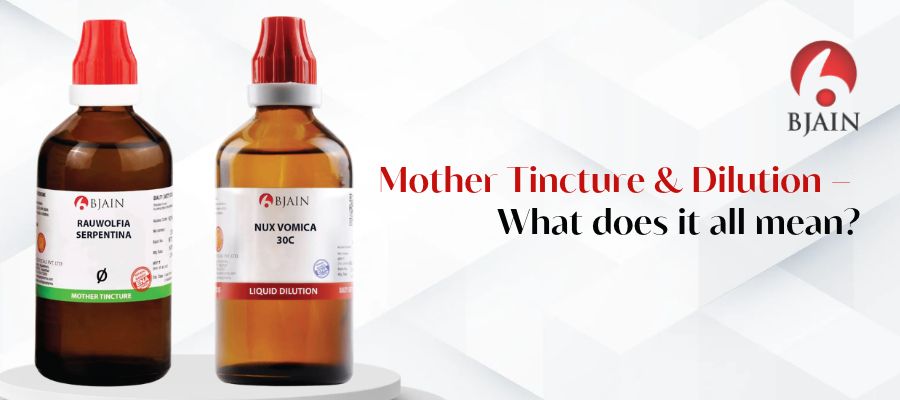
When you pick up a bottle of homoeopathic medicine, you will often see the letters Q, 6X, 30C or 200C. Whilst many people would assume this indicates the strength of the medicine, this is not the case, really. Instead, it indicates how the medicine has been made. Once you understand how to read the labels, this can be very straightforward and simple.
This guide will explain in simple terms what all this means. Whether you’re a doctor, student or first-time buyer, this will surely help.
Quick facts
- Mother tinctures have the letter Q or φ.
- Dilutions (Potencies) are made using a step-by-step procedure. The letters refer to X, C or LM.
- They aren’t stronger or better, just different ways of making the medicine. It’s up to your prescriber to decide which is right for you.
What is a Mother Tincture?
Many homoeopathic medicines start as a Mother Tincture. This is when a piece of plant (either fresh or dried) is placed into a mixture of alcohol and water. The plant constituents are drawn out and left with the remaining plant matter being filtered off. The result is the Mother Tincture of that very plant.
Each drug has its own recipe, which can be found in the Homoeopathic Pharmacopoeia of India (HPI). Many plant monographs, such as Abrotanum, will also give you a ‘drug strength 1/10. This means a specific amount of the plant has been mixed with water and strong alcohol and made up to one litre of tincture. Each drug will have its own specific recipe. Always check the monograph.
Mother tinctures will have the letter φ (Greek letter phi) or Q on the label. As minerals and metals won’t dissolve in alcohol, they will be made differently, as explained below.
What is a dilution (Potency)?
A dilution is made by a step-by-step process. A measured amount of the previous preparation is mixed with a measured amount of diluent. It is then shaken in a specific way. This is known as succussion, and the whole process is known as potentisation.
The label will tell you what type of dilution it is and how many steps have been taken.
The decimal dilution is made by adding 1 part of the preparation to 9 parts of the vehicle. It is then given 10 succussions.
The centesimal is made by having the first potency contain 1/100 of the drug, and then each subsequent potency contains 1/100 of the previous one.
The 50 millesimal scale relates to Hahnemann’s Organon of Medicine (6 th edition), section 269-271.
Some substances are insoluble, so they would be made by grinding with lactose (trituration). Once a 6X trituration has been achieved, liquid potencies can be made. The first liquid potency from this would be 8X (equal to 4C).
Dosage forms
There are various dosage forms available depending on what your prescriber has decided and the type of medicine.
Drops – Mother Tincture or liquid dilution. Usually measured into a small amount of water.
Globules (Pellets) – Sugar pellets with the dilution.
Tablets & Powders – Triturations and Biochemics.
External – Some mother tinctures are made into lotions or ointments.
How to read the label
Look for:
The name of the medicine with a Q or φ at the end. This means it’s a Mother Tincture.
The name of the medicine with a number and letter (X/C/LM). This means it’s a dilution and tells you what type of dilution it is and how many steps have been taken.
The dosage form and quantity (drops, pellets, tablets, ml/g). Tells you what you have.
Batch number, date of manufacture, expiry date & manufacturer. Useful if you want to reorder.
Note: In some countries and older books Q can mean something else. If unsure ask your prescriber or pharmacist.
Are the Q-named medicines stronger?
No. They are just different ways of making the medicine. The higher the number doesn’t mean it’s better. Q just means it is a Mother Tincture. Your prescriber will have chosen what type of dosage form and what dilution to use based on the patient, complaint and medicine. It’s not a good idea to choose a number yourself.
Examples of labels from BJAIN
Below are examples of labels to help you understand what they look like.
BJAIN Hamamelis Q Mother Tincture & BJAIN Ginseng Mother Tincture both have Q.
BJAIN Calcarea Carbonica Liquid Dilution shows you how you receive a mineral-derived medicine.
BJAIN Baryta Carbonica Dilution.
Questions to ask your prescriber
- Is this a Mother Tincture or a dilution, and why have you chosen this for me/child?
- What do the letters and numbers on the label mean?
- How many drops/pellets should I take, how often and for how long?
- Should I take it with water? Should it be taken away from food and drink?
- Is there an issue with the alcohol content for a child, pregnancy or if I avoid alcohol?
- Is this for internal or external use?
- How does this work with my other medications? When should I come back for a review?
FAQs
Q: Does Q mean it’s stronger than 30C?
A: No. Q means it is a Mother Tincture. 30C means it’s a dilution. They don’t compare.
Q: Can I change between the different types?
A: Please don’t. The dosage form, scale and dose have been chosen specifically for the individual case. Always ask.
Q: Why do some labels have a φ?
A: This means it is a Mother Tincture. φ is the symbol used in the pharmacopoeia. Q is commonly used on labels.
Storage
Store your bottles in a cool, dry place out of direct sunlight and strong odours.
Always store out of reach of children.
Check the expiry date and don’t use if the seal has been broken.
Summary
A Mother Tincture is the starting extract and will have a Q or φ. A dilution is made using a step-by-step process and will have the letters X/C/LM. They are different ways of making the medicine and aren’t higher or lower compared to each other. If you can read the labels and ask the right questions of your physician.
Explore the range
You can find mother tinctures and dilutions on our website. However, your registered homoeopathic physician will always be the best source of information regarding any medicine.
References
Pharmacopoeia Commission for Indian Medicine & Homoeopathy (PCIM&H). About us. [Online] Available from: portal.pcimh.gov.in
National Health Portal, Government of India. Homoeopathic Pharmacopoeia of India (HPI). [Online] Available from: nhp.gov.in
Homoeopathic Pharmacopoeia of India. Government of India. [Insert volume, general notices/appendix on how to make potencies & page number from your copy].
Hahnemann S. Organon of Medicine 6 th edition. Section 269-271. [Insert edition & translator].
Central Council for Research in Homoeopathy (CCRH). Ministry of Ayush. [Online] Available from: ccrhindia.nic.in Indian Journal of Research in Homoeopathy. [Online] Available from: ijrh.researchcommons.org

Dr. Prashant Tiwari is a qualified homeopathic physician holding a BHMS from Delhi University and an FCAH from Maharashtra University of Health Sciences. Currently serving as a Research Officer in the R&D Department at Bjain Pharmaceuticals, Noida, he combines scientific precision with classical homeopathic wisdom to develop evidence-based, innovative formulations. His work reflects a deep commitment to quality, compliance, and advancement in homeopathic therapeutics. With a strong foundation in both clinical practice and research methodology, He contributes to bridging traditional healing principles with modern scientific standards.
