


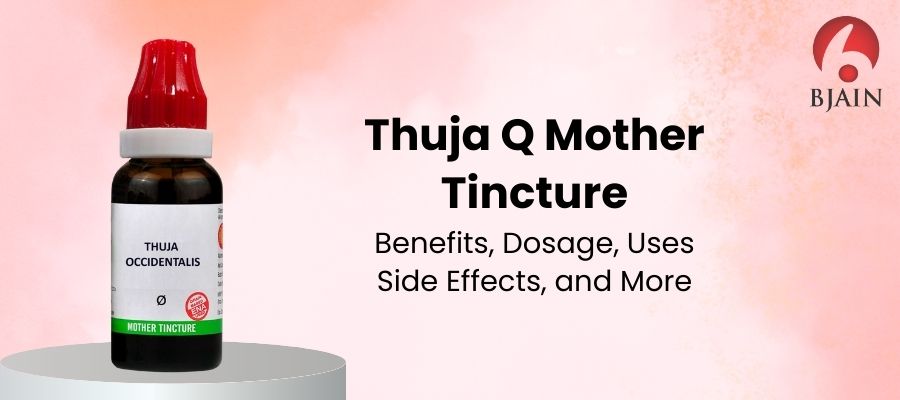
If you’ve ever wandered into the medicinal world of homoeopathy, you’ve probably come across Thuja Q mother tincture. It is beautifully derived from the evergreen The Thuja occidentalis tree, also known as the arborvitae—this remedy has been a staple remedy in traditional and alternative medicine for centuries. If you’re dealing with skin issues like warts or looking for the best and the most natural support for joint discomfort, Thuja Q often comes up in conversations about holistic health. But exactly how do you use it in the best possible way? What are its real benefits, potential side effects, and important precautions? In this comprehensive guide, we’ll break it all down in a straightforward way—no nonsense, just facts backed by traditional uses and regulatory insights.
Homoeopathy works on the principle of “Let likes be cured by like,” but results vary in most of the cases. It’s advice to always consult a qualified homoeopathic practitioner or doctor before starting any new treatment, especially if you have underlying health conditions.
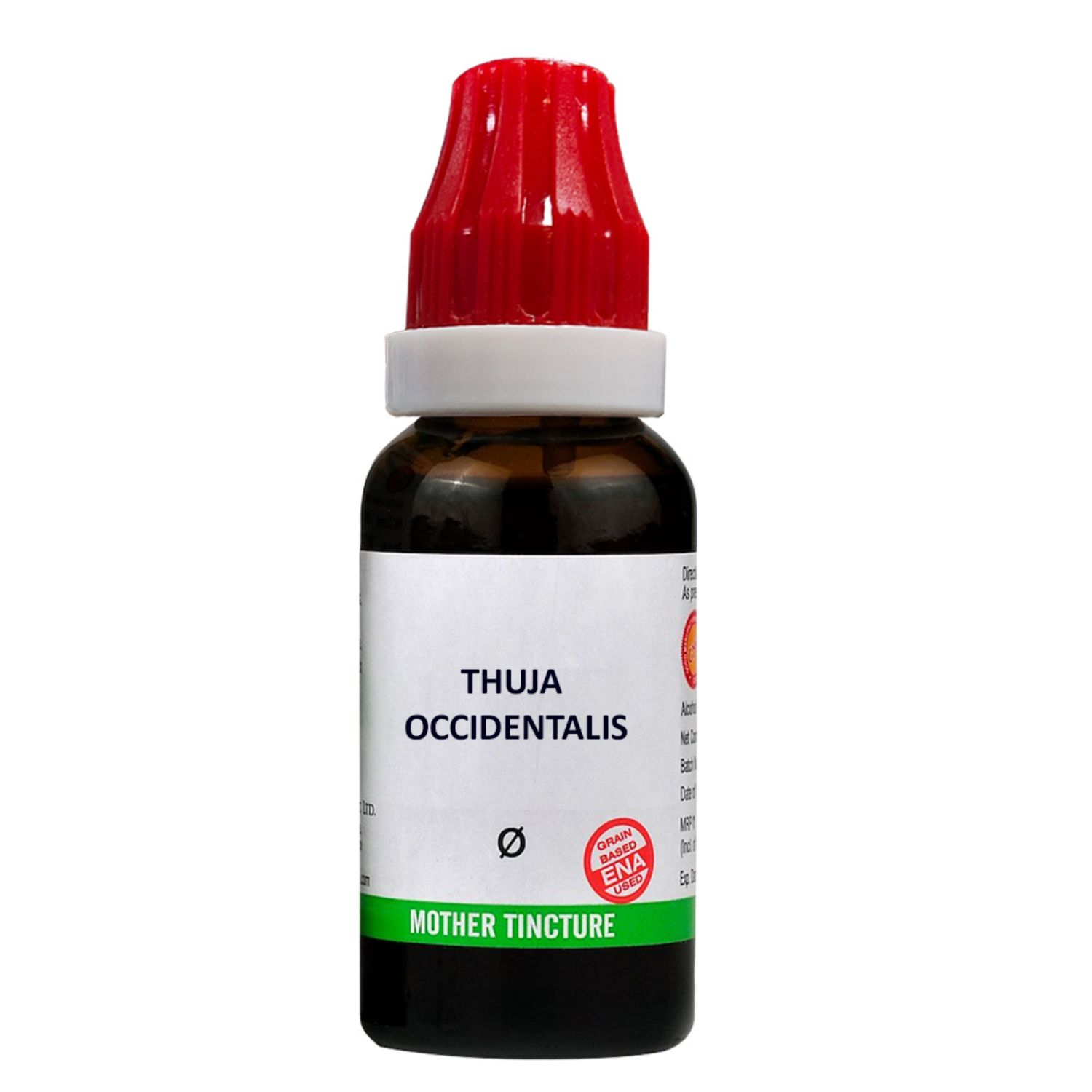
What Is Thuja Q Mother Tincture?
The plant Thuja occidentalis, which is native to North America and parts of Europe, is a coniferous tree with scale-like leaves and small cones. In homoeopathy, the mother tincture (often labelled as “Q”) is the concentrated extract made from the fresh young twigs and leaves. The homoeopathic preparation involves macerating the plant material in alcohol and water, following strict guidelines from the Homoeopathic Pharmacopoeia of India (HPI).
The key active principle found in this great remedy, Thuja, includes thujone (a volatile oil), flavonoids, and polysaccharides, which contribute to its reputed therapeutic properties. This traditional medicine, Thuja, has been used by indigenous communities for everything from respiratory ailments to skin conditions. Homoeopathy amplifies this by diluting the tincture into potencies, but the mother tincture itself is the undiluted form, which is more potent and direct.
Why is “Q” used?
In Homeopathic Medicines It’s shorthand for “mother tincture” in homoeopathic notation, distinguishing it from higher dilutions like 30C, 200C, 1M, etc. If you’re searching for “Thuja occidentalis mother tincture uses”, you’re in the right place to learn. This form is popular for topical and oral applications.
Traditional and Homeopathic Uses of Thuja Q
Thuja Q has a very long history in herbal and homoeopathic practices. It’s good to remember that these are based on traditional reports and anecdotal evidence; scientific studies are limited, and it’s not a substitute for conventional medicine.
The best and the most common “Thuja tincture benefit” is for skin-related issues. It’s often recommended and advised for warts, including common, plantar, and genital varieties caused by the human papillomavirus (HPV). The concerned user can apply it topically or take it orally to potentially stimulate the body’s immune response. In homoeopathy, it’s linked to “sycotic” constitutions—think overgrowths like polyps or skin tags.
Support for the respiratory system is another big area. It’s uses include easing bronchitis, coughs, and sinus issues by acting as an expectorant to loosen phlegm from the respiratory tracts. One of a best use of this is using it for herpes labialis due to its anti viral properties.
Thuja also greatly help with osteoarthritis, rheumatism, and trigeminal neuralgia—a nerve disorder causing facial pain. It’s considered to reduce inflammation and improve mobility, making it a go-to for “Thuja mother tincture for arthritis-like complaints.
Other useful applications are as follows:
- Boosting immunity post-vaccination or during infections.
- Addressing urinary issues like enuresis (bedwetting) or cystitis.
- Supporting women’s health, such as amenorrhoea (absent periods), though evidence is less in this context.
- In some traditions, it’s used for psoriasis, eczema, and even as a diuretic.
Research done with Thuja plant:
A review in 2020 in the journal Molecules points out its botanical uses for liver diseases, diarrhoea, and rheumatism, while a study this year in the Asian Pacific Journal of Tropical Medicine points out its potential in modern phytotherapy. In sum, it’s considered a blessing in the field of homoeopathy.
How to Use Thuja Q Mother Tincture: Dosage and Administration
The usually recommended dosage is 10-15 drops in half a cup of water, 2-3 times daily. But this again varies from condition to condition and person to person, and it is always advisable to use it under the guidance of a practitioner.
For oral (internal) use: Add 10-15 drops in water and drink it slowly over a few hours. Avoid food or drink 15-30 minutes before/after, allowing maximum absorption.
For topical (external) use: Add 5-10 drops in water or in any carrier oil and apply it to the affected areas, such as warts. Tie it up with a bandage for better results in the long run.
It should be used 2-3 times in skin problems. Its application is short-term for acute conditions, which are mainly for some weeks, though chronic cases may need further time along with supervision.
Pro tip for “Thuja Q dosage for warts”: Start slow and monitor your concern. Also, combine with lifestyle tweaks like boosting vitamin C and vitamin D3 for immune support.
Who all should avoid it?
- Pregnant or nursing women, as it is traditionally associated with abortions.
- For all those who have any autoimmune diseases, it can overactivate their immune system
- For all those individuals with seizure disorders or an allergy to conifers.
- Interactions – It is known to enhance the function of immunity-boosting herbs or may interact with certain medications. So consult your physician before you start using it.
Medicolegal Aspects: It’s Validation from Indian Laws
In India, Thuja Occidentalis Mother tincture is practised under the AYUSH ministry, and it is ensured for safety and quality. According to the Drugs and Cosmetics Act and HPI standards, it follows Good Manufacturing Practices to avoid any impurities or incorrect labelling.
Final verdict: Is Thuja Q Right for You?
Yes, Thuja Q mother tincture is the wonder of nature’s pharmacy, with its uses in warts, skin problems, joint pain, and others. The antioxidant and anti-inflammatory properties, as mentioned in research, are the ideal uses of Thuja Q mother tincture in today’s time.
FAQs on How to Use Thuja Q Mother Tincture
Q1. What is Thuja Q Mother Tincture?
Ans – Thuja Q (Thuja occidentalis mother tincture) is a homoeopathic extract from the arborvitae tree’s fresh twigs and leaves, used as the base for many remedies.
Q2. What are the main uses of Thuja Q?
Ans – Common traditional uses: warts, skin tags, polyps; coughs, bronchitis; arthritis, rheumatism; bedwetting; immunity support; irregular periods.
Q3. How effective is Thuja Q for warts?
Ans – Many report good results for common, plantar, and genital warts via topical or oral use, but results vary. Not a guaranteed cure—consult a doctor.
Q4. What is the recommended Thuja Q dosage for adults?
Ans – 10–15 drops in half a cup of water, 2–3 times daily (oral). For Topical use: dilute 5–10 drops in water and apply 2–3 times a day, OR you can follow the practitioner’s advice.
Q5. Can children use the Thuja Q safely?
Ans – Yes, with professional guidance—usually 5–10 drops or as prescribed by your physician.
Q6. What are some possible side effects of Thuja Mother Tincture?
Ans – Some common side effects include nausea, vomiting, diarrhoea, and skin irritation. Rare side effects include seizures, asthma, or organ issues from overuse. Stop the use of the medicine if any side effect occurs.
Q7. Is Thuja Q safe to ingest or apply during pregnancy or breastfeeding?
Ans – No—generally avoided due to possible risks. Consult a doctor before you use it.
Q8. In which conditions or cases does Thuja Q work in homoeopathy?
Ans – It follows “like cures like”, targeting overgrowths and inflammations with compounds like thujone and flavonoids for immune and anti-inflammatory support.
Q9. What are some of the active principles in Thuja Occidentalis Mother Tincture?
Ans – Active principles like Thujone, flavonoids, polysaccharides, tannins, etc. are derived from the Thuja tree.
Q10. Can Thuja Q interact with any other medications a person is taking?
Ans – Yes—may affect immune drugs or herbs. Always consult your doctor before you start it.
Q11. How should one can store Thuja Q Mother Tincture?
Ans – Keep in a cool, dark place (<30°C), tightly closed.
Q12. Is Thuja Q regulated and looked at under Indian laws?
Ans – Yes—governed by the Drugs and Cosmetics Act, 1940, and the Drugs and Magic Remedies Act, 1954.
Q13. Where can I buy authentic and correct Thuja mother tincture (Q)?
Ans – From trusted brands like Bjain from different websites like Amazon, Flipkart, Tata 1mg, etc.
Q14. What happens if I overdose on Thuja Q?
Ans – Overdose may cause convulsions, breathing issues, or organ strain. Seek emergency help immediately if there are any side effects.
Q15. Can Thuja Q be used long-term for arthritis?
Ans – Yes, under the supervision of a homoeopathic practitioner for chronic issues like arthritis and other joint-related concerns.

Dr Kiran Swami
Dr. Kiran Swami, BHMS, MD (Hom.), a Research Officer at BJain Pharmaceuticals Pvt. Ltd., holds degrees from Nehru Homeopathic Medical College, Delhi, and Dr. Sarvepalli Radhakrishnan Rajasthan Ayurved University, Jodhpur. With expertise in homeopathy and a passion for research, she drives innovation in holistic healthcare solutions.
